Showing posts with label Argentina. Show all posts

Saturday, 30 June 2012

The 3 Scariest Things I Ever Did On My Travels


For those who think hopping on a plane for a trip to London or Paris or Mexico City is adventurous and dangerous, this post may be hard to relate to. I started hitchhiking across America when I was 13. I hitched from Brooklyn to L.A. when I was 15 and stowed away on ship so I could make a new, simpler life for myself on Tonga. I celebrated my 21st birthday in my home-- a thatch-roofed bungalow steps from the Arabian Sea in Goa. But this morning, after reading about the latest deprecation in war-torn Mali, I tried to recall what the most dangerous stunts I had pulled on my travels.

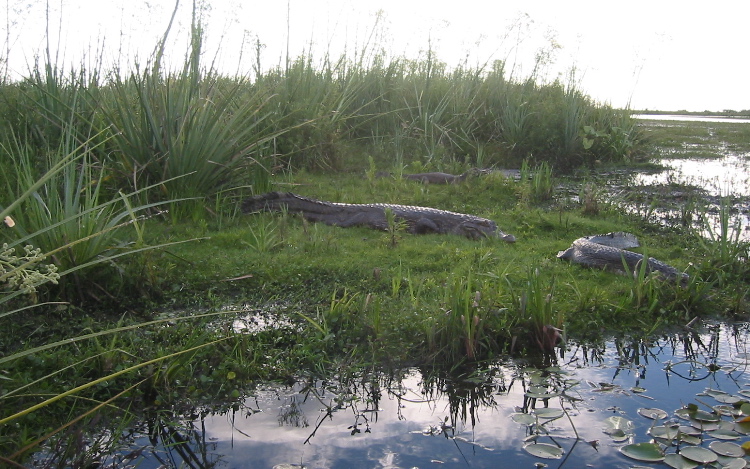
Because I was swimming when I was thinking about it-- and because I get really scared of crocodiles and alligators-- one that popped into my mind was a trip to Esteros del Iber� a swampy section of northern Argentina where Argentina, Brazil and Paraguay all come together. They call it the Serengeti of Latin America because of the abundance of wildlife and, as I noted at the time, "the most important thing was to get the idea of "swamp" out of my head. This was easy because the place is not only gorgeous, it is fresh and even cooler than everyplace around it. The water is so beautiful that if it weren't for the alligators, pirhanas, capybaras and anacondas, you'd want to jump right in-- as many of the folks who live around there do anyway (and have the missing fingers and toes to prove it)."

Alligators-- they call them Yacare Caiman in the neighborhood, like the fella in the picture-- are something I usually go out of my way to avoid. So, for me, the scariest moment came when I agreed to go with a local in a dugout canoe for an afternoon of caiman, capybara (word's biggest rodent) and anaconda watching. And for hours that's all I saw... not anacondas, just a billion alligators and giant prehistoric rats.

Years earlier I had a run-in with an even scarier creature. I was bumming around Afghanistan in 1969 and found myself captured by a militia up in the mountains. I didn't understand a word of Pashtun at the time-- I learned a few months later when I got snowed in and stranded in a tiny Pashtun village for the winter-- but I sure understood the universal motions and grunts for "put your hands over your head or I'll unload this Kalashnikov into it." So I did. Maybe they wanted to go for a Ripley's Believe It Or Not Record, but they just had us keep our hands over our heads for hours. Eventually some Australian hippie who was with me-- and peaking on acid-- just started laughing and lowered his hands. At first the Afs all started screaming menacingly and made like they were about to shoot us. Then I started laughing and lowered my hands too. And then everyone else did-- and soon we were sitting around the campfire drinking tea with the militia all laughing away and smoking opiated hash like we were all best friends.

Most recently though, Roland and I went to Mali and wound up in Timbuktu on the outskirts of the Sahara Desert. It's not really the outskirts anymore; the desert is encroaching rapidly and the streets get covered in sand all the time. One night we decided to go with Mohammed, our Tuareg guide, into the Sahara itself. It's trackless; there's nothing but sand dunes and the light is the moon and stars and our flashlights. Our destination: a Tuareg encampment a few miles away where some nomads had come down from the desert to trade. We were leaving for America in a few days and there was plenty of stuff to trade-- from my high-end REI walking sticks to cans of sardines Roland had brought... and toilet paper, airline shaving kits, bits and pieces of clothes... all kinds of stuff we didn't want to schlepp back to L.A. It went pretty well. It might not have. As I've been writing in the last few months, a Tuareg rebellion was brewing and it's boiled over... big time. They've seized two-thirds of the country. And these are bad guys; they believe slavery is condoned by their religion, for example. And in the name of their primitive and ignorant concept of Islam, they are destroying Timbuktu, ironically a centuries-old center of Islamic learning.
Armed fighters of Mali's al-Qaida-linked Ansar Dine Islamist group on Saturday destroyed mausoleums in the ancient trading city of Timbuktu, classified as a UNESCO World Heritage site, witnesses said.

The attack came just four days after UNESCO agreed to a request by the West African state to place Timbuktu on its list of heritage sites in danger following the seizure of its northern two-thirds in April by separatist and Islamist rebels.

"They have already completely destroyed the mausoleum of Sidi Mahmoud (Ben Amar) and two others. They said they would continue all day and destroy all 16," local Malian journalist Yeya Tandina said by telephone of the 16 most prized resting grounds of local saints in the town.

"They are armed and have surrounded the sites with pick-up trucks. The population is just looking on helplessly," he said, adding that the Islamists were currently taking pick-axes to the mausoleum of Sidi El Mokhtar, another cherished local saint.

Roland is protesting because I didn't include the time I was stranded on a coral reef in Sri Lanka and the time we almost drove over a cliff in the High Atlas Mountains of Morocco south of Marrakech.

Monday, 8 January 2007

CRIME IN ARGENTINA, TAKE TWO

One of the highlights of traveling is always the folks you meet. My trip to Argentina was especially rich in this way and I was lucky that so many people in Argentina speak English and that my L.A. Spanish got me around otherwise. One of the people I was most impressed with is a remarkable woman named Amelia, a music business connection, who I went to dinner with when I first arrived. Our mutual friend Steve, k.d. lang's manager, had introduced us via e-mail. Amelia had been arrested during the time when the generals ran a fascist state in Argentina (the most recent, historically speaking)-- and she's a vegetarian; we got along great. Today she e-mailed me with a critique of a blog I wrote a couple weeks ago about safety in Buenos Aires.


ABOUT THE UNSAFE CITY

by Amelia Lafferriere


Think back to the ear of Menem, our Arab Muslim-converted-Christian-(for the sake of politics) president (1989-1999), who introduced Argentina to the quick fix policies of neoliberall economic politics with its systemic unemployment policies and de-industrialization. strong introducer(the first after the militars),and Supposedly a close friend and huntig companions of the Bush family, Menem followed the military dictatorship. His policies converted the country into a desert in terms of productive industry and real jobs-- which continued under De la Rua-- and created a deep chasm between rich and poor, nearly annihilating the middle class (a middle class which had been the pride of Argnetina, the only country in Latin America that had managed to maintain a strong and healthy middle class over the decades).


Buenos Aires, where, as you so correctly mention, half of the population live if we put together the Capital and Gran Buenos Aires, started its process of economic and then social degradation. Menem presided over recession, hyperinflation, privitiziation of ultilities and a tidal wave of foreign "investment." Menem's endemic corruption and his quick fix policies got him re-elected but they were catastrophic for the long-term financial and social health of Argentina, leading to bankruptcy and severe dislocation in every sphere of human endeavor. Parallel worlds began to take root-- a world of the rich and a world of everyone else.

Shopping centers and gated communities for the wealthy were sprouting up, here and there-- like gentrified Puerto Madero, funded by international capital... while social welfare was left to rot and whither away on the vine.

People of the suburbs, with no work and no future started to invade the city, sometimes taking empty old abandoned houses and turning to street robbery to get by. The result: growing unsafety and insecurity for the society. (Current policies about this issues are not helping, but that s another song.)

There are a lot of tourists coming all the time and sometimes they are very visible for these desperate people, making them obvious targets, not to say that locals do not suffer this unsafety as well, probably far more, in fact.

Regarding major crime-- like kidnapping and car theft sometimes leading to murder-- it is often that we find bands of ex-policemen working in combination with lumpen proletariat from the exurban villas (barrios), doing all this, most frequently in the suburbs. I'll call this a residual of last military government (what is called mano de obra desocupada, this meaning that these people were employed in kidnaping and robbing people for political reasons and when democracy came back, they had no "legitimate" work... so they changed their targets. We have been in "democracy" since 1983 but this situation continues today.)

What I can conclude is that Buenos Aires at this time has more insecurity and less safety than it had ten years ago. There are neighborhoods that are more exposed , especially those visited by tourists, although all neighborhoods throughout Buenos Aires suffer the situation, Fortunately we can say that so far the kinds of robbery prevelent in Buenos Aires is NOT followed by murder... most of the time.

Anyway the climax of unsafety of Argentine society comes with the fact that we have a high profile political missing person for over 3 months. Mr Julio Lopez, a worker who had been kidnapped and tortured in the seventies, and who remained alive by chance, has given in the trial to one of his captors ,a miliray government sanctioned murderer named Etchecolaz. After his testimony-- on his way to hear the judge read Etchecolaz' sentence-- he vanished.

Etchecolaz is now in prison, where he belonged many years ago, but Mr Lopez, a 78 years old man, seems to have suffered a kidnapping for the second time, and we all presume he is dead.

The very idea that this could happen now, is really frightening-- and although it does not affect everyday life on the surface, the way it used to in the seventies, for me is the most serious security and safety problem we have at this moment...

Like in all big cities, but starting in Buenos Aires in the '90s, drugs have become a terrible problem, mostly cheap and low quality drugs that are readily available in the impoverished suburban neighborhoods. That and the lack of opportunities for people are the keys to a developing culture of crime here.

Still, I like to think that the pulse of this city has to be taken in view of the continuous work in the cultural arenas. People are massively working in the fields of music, cinema, theatre, education... putting on festivals. Universities are still free in Argentina and the fact that two graduates have recently won Nobel prizes are a great source of inspiration for many people. Buenos Aires is a place where you find friendly peopl everywhere, where you can spend several hours in a cafe-- and for the price of a cup of coffee, you can read the newspapers of the day, or a book, talk with people who see conversation as a living art, people with open minds who make it possible to have so many different cultural expressions welcome all the time in the city. Still today Buenos Aires is a city with a pacific coexistance of different religions, as Jew (Argentina is the second country in numer of Jewish population after Israel and the U.S.) and Arabs and Muslims. We have often ecumenical ceremonies of all the religions together with Catholic and different Christian churches, together with the Jewish and the Muslim faiths.

Could this be-- the remains of what Argentina was going to be and didn't come to be, but still a part of it.-- breathing... and helping us all breathe and hope.


UPDATE: A SLIGHTLY MORE POLITICAL LOOK AT THIS

I did a piece over at Down With Tyranny if you'd like to look at it from an even more political perspective.

Saturday, 6 January 2007

WHAT'S BETTER-- RENTING YOUR OWN PLACE OR STAYING IN A HOTEL?


I think the first time I figured out that, generally speaking, renting a place was better than staying in a hotel was 1970. I rented a house for a couple of months on the beach in Goa. Once I figured out the function of the herd of pigs on the property, everything was smooth as silk and I settled in for a nice leisurely stay in my very first post-college home-of-my-own. It took me about 3 days to convince myself that I was actually a Goan and start, relatively speaking, integrating myself into the pulse of the community. I don't recall ever seeing a hotel in Goa although I'd hear from the hippies and other travelers who came to our beach-- the one that was 30 steps from my front door-- that there were hotels.

When you're staying in a place for less than a month, renting a place is tough. After my 10th trip to Thailand I finally figured out that a secluded villa on Phuket was way more what I was looking for than a berth at even the nicest of hotels. I don't think I ever put on any clothes for weeks at a time. And then a couple years ago I rented a villa overlooking the Ayung River in central Bali. Except to go pick up a friend who was staying at the Ritz, I never even visited the tourist ghetto on the island and, as far as I could tell from my vantage over the Ayung, I was indeed the only non-Balinese on the entire island.

These days, whenever I can, I always rent an apartment or a house rather than stay in a hotel. So, when planning my trip to Argentina a few months ago I was delighted when Lieber, an Argentine waiter at my favorite raw foods restaurant, told me that renting apartments was a very normal thing to do in Buenos Aires for anyone staying at least a week. Perfect! I found what looked like a reputable rental agency that specializes in dealing with foreigners and quickly found an apartment in the part of town (Recoleta) everybody was telling me was the safest and best located.

The apartment was perfect, right on Posadas, across the street from the Four Seasons Hotel-- a light, airy, well-kept one bedroom, with a living room, dining area and kitchenette, fully supplied with everything from sheets and silverware to a free phone for local calls, Wi-FI, a doorman and daily maid service. And the price? Prices vary based on location, size, all that stuff, but generally it costs for a week what you would pay for a night in a comparable hotel.

The agency I used was BytArgentina and I couldn't find anything online about them being unscrupulous or anything like that. My experience with the agents I used on Bali, BaliVillas, was superb and I just assumed-- uh oh-- that BytArgentina would be as good. They weren't-- and I mentioned what went wrong in a story I did a couple weeks ago about safety and scams in Buenos Aires.

In this case, the company (or perhaps the owner of the apartment, more likely), shrewdly not accepting credit cards, only cash, managed to separate me from $500. I had no recourse other than to suck it up. Something similar had happened to me in Tangier decades ago at the El Minzah Hotel (best in town), a $100 travelers check having been removed from the safe behind the reception desk! Left me with a bad taste in my mouth, but, after trying a couple of less grand hotels, I wound up back at the El Minzah a few times since. I know for sure I'd never rent an apartment through BytArgentina again (nor from Graciela Ujaque, the owner of the apartment). Would I rent an apartment in Buenos AIres again? 100% yes. Let me tell you why.

Aside from getting a sense of belonging to a culture that most hotel guests can never experience, there are some tangible reasons I like to get my own place. I don't eat junk food and I take breakfast seriously. Even in NYC, where I do stay in a hotel, I always get one with a kitchenette. That way I can stock up on healthy goodies (fruits, nuts, etc) and on breakfast goods (blueberries, melons, papayas, lemons...) and have a place to store them and prepare them conveniently. It is virtually always much less expensive to rent your own place than to stay in a hotel. And it's far more personal.

Not everyone agrees, of course. One of my friends found my luxurious villa (with 4 servants-- including the best cook on the island of Bali-- and a swimming pool) akin to camping out. She was eager to move to the more... sterile environment of the Ritz. (I talked about that syndrome a little when I discussed the Park Hyatt in Buenos Aires a few weeks ago.) Some people, maybe most, would prefer to be pampered and to have everything done for them, something more likely in a hotel. Me, I like going to the local markets and shopping for day to day stuff. You start to feel the rhythm of the town's life. Last time I stayed in Marrakesh, I gave up on the Mamounia and stayed in a riad instead, sort of halfway between a hotel and an apartment; well, not halfway, but we definitely had the feeling of being part of the neighborhood.

Saturday, 30 December 2006

MY FAVORITE RESTAURANTS IN BUENOS AIRES


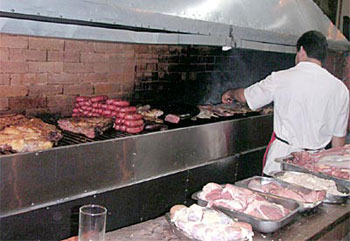
There's something perverse about a non meat-eater writing a guide to Argentine restaurants. Meat is the biggest deal down there. Everyone I ran into was so proud that Argentine beef is the best in the world-- and with the least cholesterol, no less! But non-meat eaters travel to Buenos Aires too. And, believe me, you can eat as well there as anywhere else. I'm not a vegetarian. I eat fish as well as vegetables. On the other hand, I don't eat sugar or anything made with flour (pasta, bread, cakes). And I love to eat. I'll do a specific paragraph below about the Buenos Aires veggie restaurant scene. But first let me say a few words about top restaurants in town.

As a prelude, I'll just mention that Argentina is a large and rich agricultural country with great quality food and a wide array of products. In the north there was tropical jungles and in the south, freezing near desolation. In between it's temperate and everything grows. Eating is good in Argentina. It might not be as cheap as it is to eat in Bolivia or Peru but for a tourist who could afford to get there, it's damn cheap. And the portions are generally really big. High quality, big portions, good prices. How you going to go wrong?

Generally recognized as THE best restaurant, Tomo 1 is in a hotel of faded glory, the PanAmericano (Crowne Plaza). Fortunately Tomo 1 isn't faded at all and it isn't of the hotel, just shares an address, Carlos Peligrini 521, right near the Obelisque, in what you might call the center of town (an absurd concept in Buenos Aires). Anyway, they serve lunch (weekdays) and dinner Monday through Saturday. It's been something of an Argentine institution since 1971 when the Concaro sisters, Ada and Ebe, opened it in a house in Belgrano. It moved to the Panamerico about 12 years ago. For an Argentine, 90 pesos for a meal is steep, like 90 dollars would be for an American in L.A. or NYC. But 90 pesos for us is around $30. And that's $30 for the best restaurant in town where every dish is mouthwatering and designed to be absolutely perfect. One sister does lunch and the other does dinner and their philosophy places flavors above all other concerns. Everything I ate there was delicious and nothing came to the table that you could get anywhere else.

If another restaurant gives it a run for its money it would be the newer (2004)-- and way hipper and more glitzy-- Casa Cruz in Palermo. The place blew me away to the point of doing something I had never done before in my life. I photographed the menu; take a look. This place is all about unique combinations of ingredients. Frommer or Fodor or something like that claims this is the best restaurant in town. I'm not going to argue with them either. It's not easy to get into though. I was unable to get reservations twice. They serve 'til 3AM or until you're finished eating.

Most concierges who you ask for the best restaurants in town will say there are 3 and add in Sucre. Sucre is excellent, but in my opinion not on the same level as Tomo 1 and Casa Cruz. It's bigger and not quite as smooth as the other two. The food's very good but not as unique or memorable. It's kind of out of the way too.

In fact, I think I'd put Oviedo, a posh Old World seafood restaurant in Barrio Norte, in as my third favorite restaurant, over Sucre. It's clubby and feels fancy but it was actually pretty relaxed and the food was superb, almost like you're eating in a grand restaurant in Spain rather than in Argentina. (And even though it's "officially" a seafood restaurant, people say they have incredible beef and lamb dishes as well.) Everything is done with a lot of flare.

Most of the tourists I talked to missed these incredible world class restaurants and were delighted to have their meals at Buenos Aires' traditional grilled meat restaurants, parrillas. People I met raved about El Obrero in La Boca and La Brigada in San Telmo as the best parrillas in town. After that everyone's second favorite choice are the omnipresent pizzerias and Italian restaurants. They literally are everywhere. Buenos Aires is almost as Italian in culture and character as it is Spanish. Buenos Aires also has Chinese restaurants, Thai restaurants, German restaurants, French restaurants, etc. And plenty of MacDonald's and crap like that too.

It wasn't hard finding good vegetarian food either. Although my favorite veggie (and organic) restaurant was Bio in Palermo, the "veggie scene" is centered around a store/restaurant called La Esquina de las Flores. Since I rented an apartment for my first week in Buenos Aires this was a place I could buy some basic groceries, although not fresh produce. And they have great take-away. The women who run it were mostly humorless, forbidding, harried and unfriendly. Right next door is another veggie place, Lotos, which is kind of Chinese veggie. Florida is the huge pedestrian street in the center where everyone walks and shops. There's a huge veggie cafeteria called Granix (open for lunch only) where you get as much as you can eat for $7. It isn't high consciousness food but it's good and tasty and a great place to go if you're hungry. I heard of 2 or 3 other veggie places that I never got to check out (including a Hare Krishna place I didn't want to check out, sugar being the main staple of the Krishna diet... which explains a lot).

Tuesday, 26 December 2006

TWO OF MY FAVORITE SPOTS IN ARGENTINA: THE IGUAZU FALLS AND ESTEROS DEL IBERA


When I originally decided to go to Argentina, it was the remoteness of Tierra del Fuego that drew me. As I explained earlier, I just wanted to go to the end of the world and be quiet and empty. But as I started planning out the trip I came upon two other places in Argentina that looked interesting and turned out to be just as soothing to the soul as Tierra del Fuego. One is very well-known, Iguazu, and one not well-known at all, Esteros del Ibera. Both are way up north jutting up into the Brazilian tropics. The former is in Misiones Province and the latter in Corrientes Province.


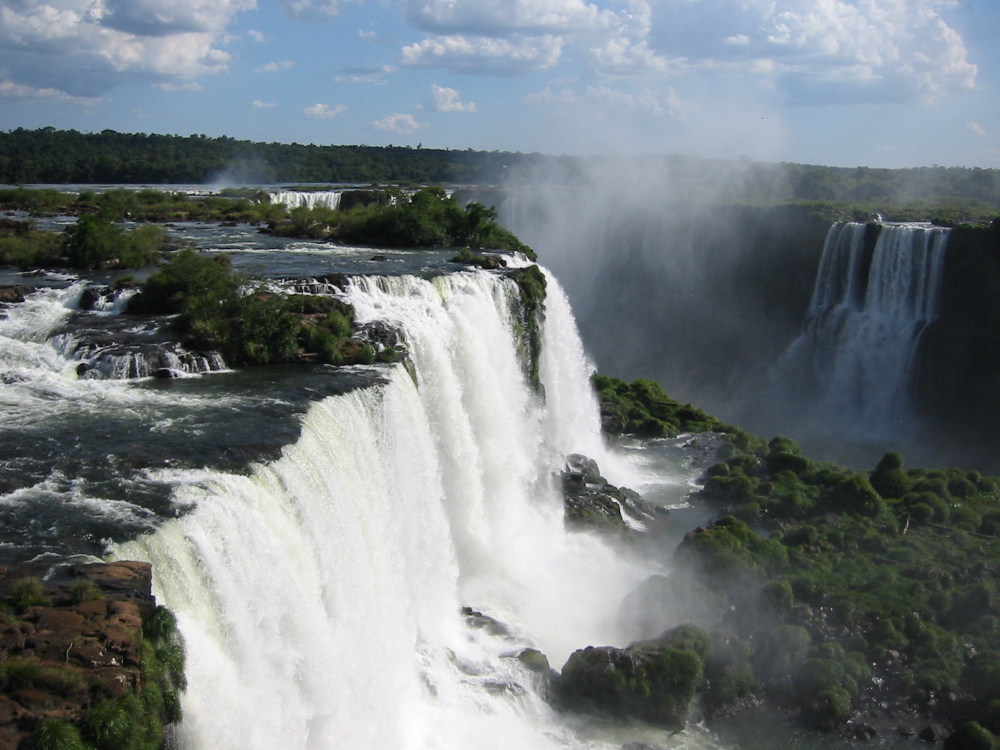
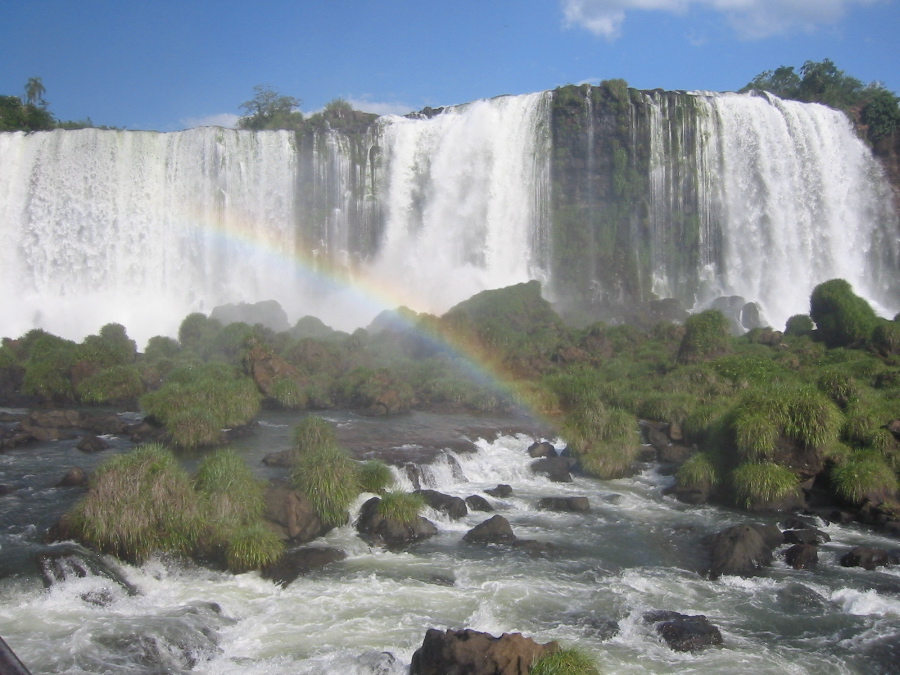
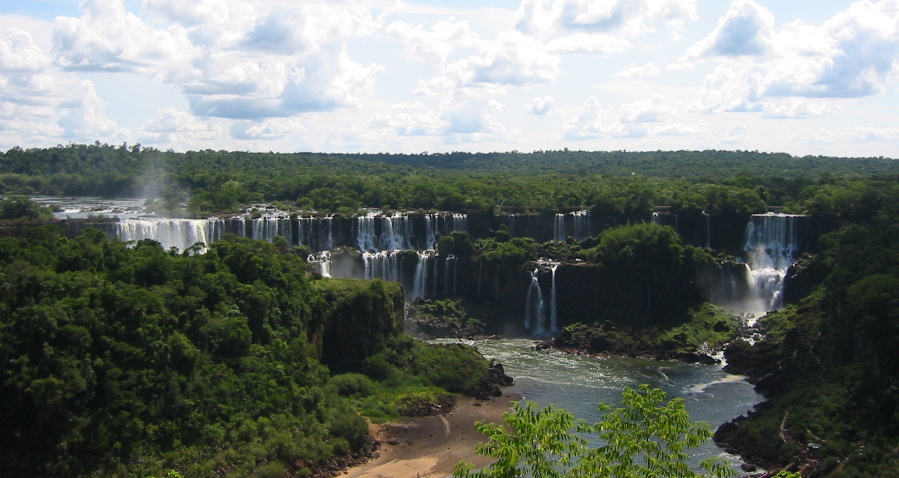
Iguazu is one of the wonders of the world and attracts millions of tourists. Located in an area where Brazil, Argentina and Paraguay meet, it is actually between 250 and 300 individual waterfalls strung out for a couple of miles. Brazil and Argentina have impressive national parks built around the falls. They positively dwarf Niagara Falls.

There are only two hotels within the national parks, a Sheraton on the Argentine side and the more luxurious-- in an old fashioned/old world kind of way-- Tropical Hotel Das Cataratas on the Brazilian side. Both are pretty expensive, primarily because of their locations inside the parks. I stayed on the Brazilian side and walked to the middle of the falls several times a day, every day-- as well as at night. The towns are miles away and not convenient. If you don't stay in the park, you have to make a trip to the falls, not just open your bedroom curtains or go for a stroll.


The problem with being at Das Cataratas is that there's nothing around and you're completely at their mercy. And they take advantage of that to charge outrageous prices for everything-- something, in fact, everyone in the area does. All services have a price for locals and a price for tourists. You want to guess which is higher? And it's a lot higher. Every hotel I stayed at, from the Park Hyatt at over $500 a night to the $35/night Julio C�sar in Posadas, let guests use their computers and Internet connections for free except one-- Das Cataratas. And in Buenos Aires the locutorios charge a peso an hour to use a computer (around thirty cents). At Das Cataratas it was something like $9 an hour. Meals were decent but not great-- and quite over-priced, there being no place else to go.


On the other hand, the falls are so spectacular and so awesome that it's worth the rip. In fact, in light of the sheer spectacularness, the rest of it is inconsequential. It's an hour and change plane ride from Buenos Aires and it is a must see. I might add the room rates were somewhat negotiable and that the service staff was friendly and eager to please.


The other place, Esteros del Ibera, I kept wanting to cancel everywhere along the planning process. I mean who voluntarily goes to a swamp? I wound up going anyway-- inertia-- and it was completely amazing. The most important thing was to get the idea of "swamp" out of my head. This was easy because the place is not only gorgeous, it is fresh and even cooler than everyplace around it. The water is so beautiful that if it weren't for the alligators, pirhanas, capybaras and anacondas, you'd want to jump right in-- as many of the folks who live around there do anyway (and have the missing fingers and toes to prove it).

It's not that easy to get there-- rutted dirt road that looks like no fun in downpour. And there is virtually no public transportation. You have to rent a 4 wheel drive vehicle in Posadas. The tour book says $85 but prices have gone up and they charge a lot more, although, they're not opposed to negotiations and discounts. My driver from Guayra Turismo was great and made the process of getting there far more pleasant than it might have been.


I stayed at an incredible, magical place called Posada de la Laguna, a top-of-the-line lodge right on the lagoon. It's the kind of place that is perfect for laying in a hammock reading and sleeping all day-- which is exactly what I did, except when I was out in the boat looking at the wildlife. The food was superb; they have a real chef who made me completely delicious vegetarian meals 3 times a day. At first I was the only guest but eventually a couple of really nice Brits backpacking around South America turned up and then a delightful couple from Montana showed up in their own van out of the blue. It was nice to be alone and it was nice to be with other guests. The whole experience was fantastic and I recommend it highly.


UPDATE: A LETTER OF RESPONSE FROM THE HOTEL DAS CATARATAS' GENERAL MANAGER


As I was checking out they asked me to fill in a comment form. I did and I touched upon some of the topics I brought up above. I just got an e-mail from Jose Acir Borges, Cataratas' general manager.
Dear Mr. Howard Klein,

In attention to the suggestions form you filled in regarding your stay at the Tropical Das Cataratas Hotel between the 04th and the 06th of December, 2006, we would like to thank you for your time and inform that it was taken in high consideration by our managerial staff.

Concerning your mention about Internet, we are mindfully analyzing it, in order to take the necessary steps.

We would also like to highlight that all the concepts and opinions expressed in the suggestions form were included in our guest evaluations statistical system, helping us improve the quality of our services.

We thank you again for your attention and preference, and take advantage of this opportunity to reinforce our strong commitment to your satisfaction.

Yours sincerely,

Jose Acir Borges
General Manager


UPDATE: ANOTHER WAY TO SEE BRAZIL-- AND LOSE SOME WEIGHT IN THE PROCESS

I wouldn't recommend trying this one, but "Slovenian Martin Strel completed his swim of the entire 3,272-mile Amazon River on Saturday, a 65-day odyssey in which he battled exhaustion and delirium while trying to avoid flesh-eating piranhas and the dreaded bloodsucking toothpick fish." He started in Peru and finished yesterday at Belem, Brazil on the Atlantic Ocean. Struggling with dizziness, vertigo, cramps, high blood pressure, diarrhea, chronic insomnia, larvae infections, dehydration, abrasions caused by the constant rubbing of his wet suit against his skin, nausea, severe sunburn and delirium, as well as the loss of 26 pounds, Mr. Strel was lucky to have escaped the interest of the piranhas, toothpick fish and bull sharks. "I think the animals have just accepted me," he explained, obviously no quite over the delirium yet. "I've been swimming with them for such a long time that they must think I'm one of them now."

Strel has already swum the lengths of the Danube (1,866-miles), the Mississippi (2,360 miles) and the Yangtze (2,487 miles). He spurns the Nile. "I am not going to do the Nile. It's long but not challenging enough, it is just a small creek. The Amazon is much more mighty." Or maybe he's sensible enough to realize the crocodiles might not be as accepting as the piranhas, bull sharks and toothpick fish.

Monday, 25 December 2006

IS BUENOS AIRES A SAFE CITY TO VISIT? SHORT ANSWER... NO, NOT REALLY

Howie at Iguazo after the "safe incident" in Buenos Aires


The most regular Google hits this site gets come from people finding a piece I wrote last Christmas called Is Morocco A Safe Place To Visit?. My conclusion, having visited the country a dozen times since 1969, is that it is. Now you don't have to go traveling around the world to find trouble; trouble'll find you anywhere, and certainly in Paris, London, New York, L.A., San Francisco, Sydney... yeah, anywhere. My luckless friend Roland has been to Marrakech three times and was robbed the first two times he was there. But I rate Marrakech safe, as well as the other big cities listed above, and Buenos Aires unsafe. Let me tell you why I came to that conclusion.

A few weeks ago, just before leaving for Buenos Aires, I was laughing about how Bush's drunken daughter was robbed in San Telmo, a Buenos Aires hotspot (while surrounded by her Secret Service bodyguards). I was laughing because there's no amount of grief that could come to that infamous family that I wouldn't find amusing-- and because the daughter is just like the father: an irresponsible jackass who can't figure out how to behave among people. However, once I spent some time in Buenos Aires I started feeling badly that I had laughed. Everyone gets robbed in Buenos Aires. Everyone? Well, no, that was an exaggeration. I wrote something the other day about how Americans that are afraid of anything foreign can stay at the Park Hyatt and be in a virtual plastic bubble of American-ness (including a safe and prophylactic environment).

On the other hand, I haven't met a single Argentine without a story about crime in Buenos Aires. Everyone who hasn't been robbed has a brother or sister or best friend who has. My friend in bucolic Posadas has two sisters who moved from Misiones to cosmopolitan Buenos Aires. Both have been robbed numerous times; one was robbed 6 times! Buenos Aires crime isn't all directed at tourists. It's directed at everyone, including tourists.

Conventional wisdom for travelers is always to be alert and use common sense and then you won't be a victim. Mostly that works. But it works less well in Buenos Aires. The stories are legion! You get everything from the mundane stuff: pickpockets, purse and camera snatchers, crooked taxi drivers... to some really exotic shit: roofies in the drink at night/naked and penniless in a strange place in the morning. I ran into a guy from Milwaukee who had driven his motorcycle all the way down from Wisconsin to Argentina. You have to be pretty tough to do that. And then he got to Buenos Aires. Tom has a great web site about his trip, and the whole thing is worth reading just because he's such an engaing writer with a refreshing perspective. But here's a segment about his misadventures in Buenos Aires:
Sadly, the two most entertaining things to write about are also the most unfortunate for me. First, I was robbed. And, second, I flirted with the possibility of serious personal injury.

The robbery took place in the morning at a small park in one of the three medians that separate the lanes in the 14-lane avenue I referenced earlier. I was reading the paper, enjoying some breakfast, when I suddenly realized that a bird had just pooped in my yogurt and on my leg. I figured this to be revenge for not sharing my donut with the crowd of birds gathered around my feet. At right around this time, a man in his 50's walked by and motioned to the birds in the tree directly above me. I stood up to survey the breadth of the poop, at which point the man directed me to a cement post a short distance away where he claimed there was water. Near the post a woman in her thirties noticed my leg and offered some of her Kleenex while addressing me in an apologetic tone. I was not in the mood to have people wiping poop off my leg, so I brushed them away. It was on the way back to the hotel that I realized that my camera was not in my pocket.

I also had had a video camera and some cash on me, so they didn�t fleece me completely But I was pretty irritated, and I had evil thoughts of breaking all of that woman�s fingers one by one. Strangely, the more I thought about it, the less upset I got. It's one thing to be robbed, but to be bamboozled by a three-person (including the deuce squirter in the grassy knoll) squad in an elaborate artificial poop ploy is quite another. I admired their audacity and originality, and, as an aside, I believe that the fake poop recipe involved a spicy mustard.


Actually, it isn't all that original. They were doing the exact same thing in Delhi in the 70's, around Connaught Place. It's just one of countless schemes Porte�os have come up with to separate people from their money and possessions. Why Buenos Aires?

There are a lot of theories, although I should point out that most of the huge Latin American cities are crime infested and relatively unsafe. Argentina is a very materialistic place and somewhat superficial to boot. Everybody who's anybody-- or wants to be-- wants to at least appear to be on top of things. That costs money. And of the 11 million residents of the city, a great many millions of them are poor. It looks like a very prosperous city, a very, very prosperous city. But you don't have to go far from the core, away from the Microcentro, from Palermo, from Recoleta, Belgrano, Retiro, Barrio Norte before you run into some serious poverty. Shanties surround the city. And there are sections right in the heart of it you don't want to walk through. A ten minute stroll from the 4 Seasons and Park Hyatt you could stumble onto Villa 31, a ghetto that many Porte�os claim is at the root of a good deal of the street crime in town. Along with urban myths about how teenage murderers cannot be legally punished and that kind of thing, you get a picture of Villa 31 being filled with young people sitting around and listening to cumbia all day-- think rap and hip-hop-- and very addicted to Paco (think crack). You'll be hard-pressed to find too much sympathy among Argentines for the residents of Villa 31 and the other villas miserias and their unfortunate inhabitants but here's the other side of the story.

So what about me? You know how I walk everywhere-- and at all times of the day and night. I walk for miles and miles in any direction and sneer at anyone who tells me it's unsafe. Did I run into any of the famous Buenos Aires street crime? Not first hand. But that doesn't mean I wasn't robbed. I wasn't robbed in one of the villas miserias though; I was robbed in Recoleta, Buenos Aires' "Beverly Hills." I was the victim of a trick at least as old as the one that Tom fell for with the pigeon poop.

I rented an apartment through a "reputable" Argentine agency that connects landlords with tourists who are spending at least a week in the capital, ByTArgentina. I picked an apartment in an upscale building on Posadas, a pretty posh street. I figured I would play it safe for my first week. What a joke! The landlady, Graciela Ujaque de Narnesi (Grace Ujaque of Buenos Aires and Miami) met me at the apartment and gave me a key to the safe so I could leave my money in it. When I left a week later, $500 was missing from the safe. ByTArgentina promised they'd get back to me; they haven't. Does that mean I won't go back to Buenos Aires? of course not. I'll just be... more alert next time.


WHAT ABOUT MEXICO CITY? IS THAT ONE SAFE?

Like I said, there are problems with all the big Latin American cities, not just Buenos Aires. New Years Eve's Washington Post did a story on the safety of traveling to Mexico's gigantic capital. The article talks about politically motivated problems and common street crime. "Street crime also has long plagued this 580-square-mile, traffic-clogged metropolis of more than 20 million residents. The list of crimes encountered by travelers is daunting: pickpocketing, purse snatching, mugging, armed robbery and rape, according to the U.S. State Department's consular information sheet on Mexico. 'Instant kidnappings,' in which the victims are abducted at gunpoint and forced to empty their bank accounts to pay a ransom, also are common. Even hailing taxis is considered risky. Is a trip to a place with so many sore spots worth it? And if you go, how best to stay safe?"

The writer insists that Mexico City has a lot of draws recommending it. He recommends avoiding certain neighborhoods and suggests avoiding oft-used scams and ye olde bullshyte line about taking "every precaution you would in any large city." As well as carrying minimal cash, leaving the bling back home and trying to "blend in." (The jewelry business in Argentina is ruined because no Portenos in their right minds wear anything real anymore.) He thinks you'll be safer if you avoid areas around the airport and central train station-- a good idea in any big city anywhere-- as well as Garibaldi Square, Pensil, Tepito, Buenos Aires and Santa Julia, the area behind the National Palace and the Zocolo at night.

Everyone says the green and white VW bug taxis are to be avoided. Even a U.S. Embassy employee in Asuncion warned me against them! The hotel concierges say the same thing about the non-radio hotels in Buenos Aires, although I found them problem-free (and less expensive).


UPDATE: GUANGZHOU IS WAY WORSE

Hong Kong is as close as I ever got to Guangzhou (Canton when I was a geography student), although I always wanted to go. After reading about the Hand Choppers, a motorcycle gang that doesn't bother removing a purse or ring but opts for severing the whole hand, I've decided to stick to Shanghai and Beijing.